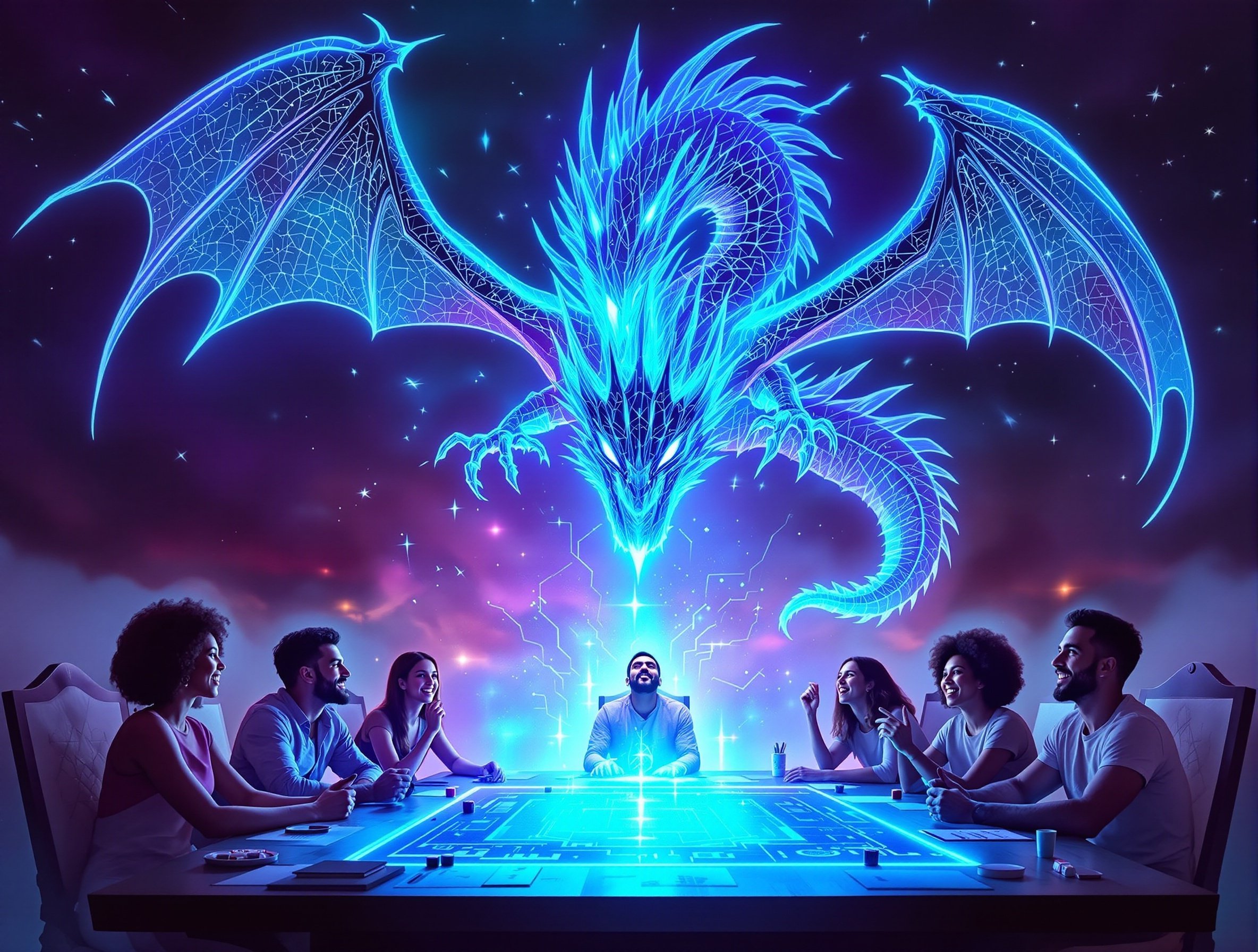
Create Your Own AI Dungeon Master for Game Night
Tired of being the forever-DM? Learn how to use ChatGPT as a creative, responsive, and endlessly surprising Dungeon Master for your next TTRPG game night.
Create Your Own AI Dungeon Master for Game Night
Introduction
Game night is sacred. Whether you're a seasoned Dungeons & Dragons veteran or a complete newcomer to tabletop role-playing games (TTRPGs), the magic of collaborative storytelling is undeniable. But being a Dungeon Master (DM) is a lot of work. You have to build a world, create characters, remember rules, and improvise at a moment's notice. What if you could have a co-pilot to handle the heavy lifting?
Enter the AI Dungeon Master. Using the power of large language models like ChatGPT, you can create a dynamic, responsive, and endlessly creative DM to run your next game. It can invent scenarios, play non-player characters (NPCs), and describe the world in vivid detail, leaving you and your friends free to focus on the adventure. This guide will show you how to set it up for an unforgettable game night.
Step 1: Choose Your AI Brain
The 'brain' of your AI DM will be a large language model. The best and most accessible option right now is ChatGPT (GPT-4 is preferred for its creativity and memory). Its ability to understand context, remember previous parts of the conversation, and play a role is perfect for a TTRPG.
You'll want to start a new chat for your game to keep the AI focused. This chat will become your game world.
Step 2: The Master Prompt (Setting the Stage)
This is the most important step. You need to give the AI its role and the rules of the game. A good master prompt sets the stage for the entire adventure. You'll want to copy and paste this into ChatGPT before you begin.
Here is a template for a great master prompt:
You are an AI Dungeon Master for a tabletop role-playing game. Your goal is to create a fun and engaging fantasy adventure for me and my friends. You will describe the world, the situations, and the non-player characters (NPCs). We, the players, will tell you what our characters do. You will then describe the outcome of our actions.
**Game Rules:**
1. **Describe the Scene:** Start by setting the scene. Where are we? What do we see, hear, and smell?
2. **Wait for Our Actions:** After you describe the scene, always end with 'What do you do?'. Do not proceed with the story until we respond.
3. **Be a Fair Referee:** When we try to do something, you will determine the outcome based on the situation. If an action is risky, you can ask us to roll a 20-sided die (d20). A roll of 1-5 is a failure, 6-10 is a partial success with a complication, 11-19 is a full success, and a 20 is a critical success with a bonus.
4. **Play the NPCs:** You will role-play all the characters we meet. Give them unique personalities, voices, and motivations.
5. **Keep it Fun:** Prioritize creativity and fun over strict rules. If we have a cool idea, let us try it.
**The Adventure Begins:**
Our story starts in the bustling port town of Saltwind. We are a group of unlikely adventurers who have just met at the 'Salty Squid' tavern. Please describe the tavern and the strange old man who has just approached our table with a mysterious map.
Why this prompt works:
- Clear Role: It tells the AI exactly what it is (
AI Dungeon Master). - Simple Rules: It establishes a simple, turn-based structure (
What do you do?) and a basic system for resolving actions (roll a d20). - Creative Freedom: It encourages the AI to be creative and fun.
- A Strong Start: It gives the AI a concrete starting point for the adventure.
Step 3: Playing the Game
Now, it's time to play! Gather your friends around the screen (or project it onto a TV). Read the AI's descriptions aloud. When the AI asks, 'What do you do?', discuss as a group and decide on your action. Type your collective action into the chat.
Player Input Example: 'My character, Thorin the dwarf, will greet the old man and ask him about the map. My friend's character, Elara the elf, will use her keen eyes to see if anyone else in the tavern is watching us.'
The AI will then take this input and generate the next part of the story. It might describe the old man's raspy voice, what Elara sees in the corner of the tavern, and then ask, 'What do you do?'
Tips for a Great AI-Powered Game Night
- Embrace the Weirdness: The AI will sometimes come up with bizarre or unexpected plot twists. Roll with it! These often lead to the most memorable moments.
- Be the Human Element: As the person typing, you can help guide the AI. If it gets stuck or forgets something, you can gently remind it in parentheses
(OOC: Remember, we have the magical amulet). You are the bridge between the players and the AI. - Use a Dice Roller App: Have a dice roller app on your phone to handle the d20 rolls. It adds to the tension and fun.
- Give Your Characters a Voice: Even though you're typing your actions, encourage your friends to speak in character. It makes the experience much more immersive.
- Don't Be Afraid to Nudge the Story: You can directly ask the AI to introduce a new element. For example:
'Suddenly, we hear a crash from the kitchen. What happens?'
Conclusion
Using an AI as your Dungeon Master is a fantastic way to experience the joy of TTRPGs without the heavy prep work. It's spontaneous, creative, and endlessly surprising. The AI is a tireless storyteller that is always ready for an adventure. It's the perfect solution for a last-minute game night, for introducing new players to the hobby, or for seasoned players who want to experience a story that is truly unpredictable.
So gather your friends, craft your master prompt, and get ready to explore a world created just for you, one prompt at a time. Your epic adventure awaits!