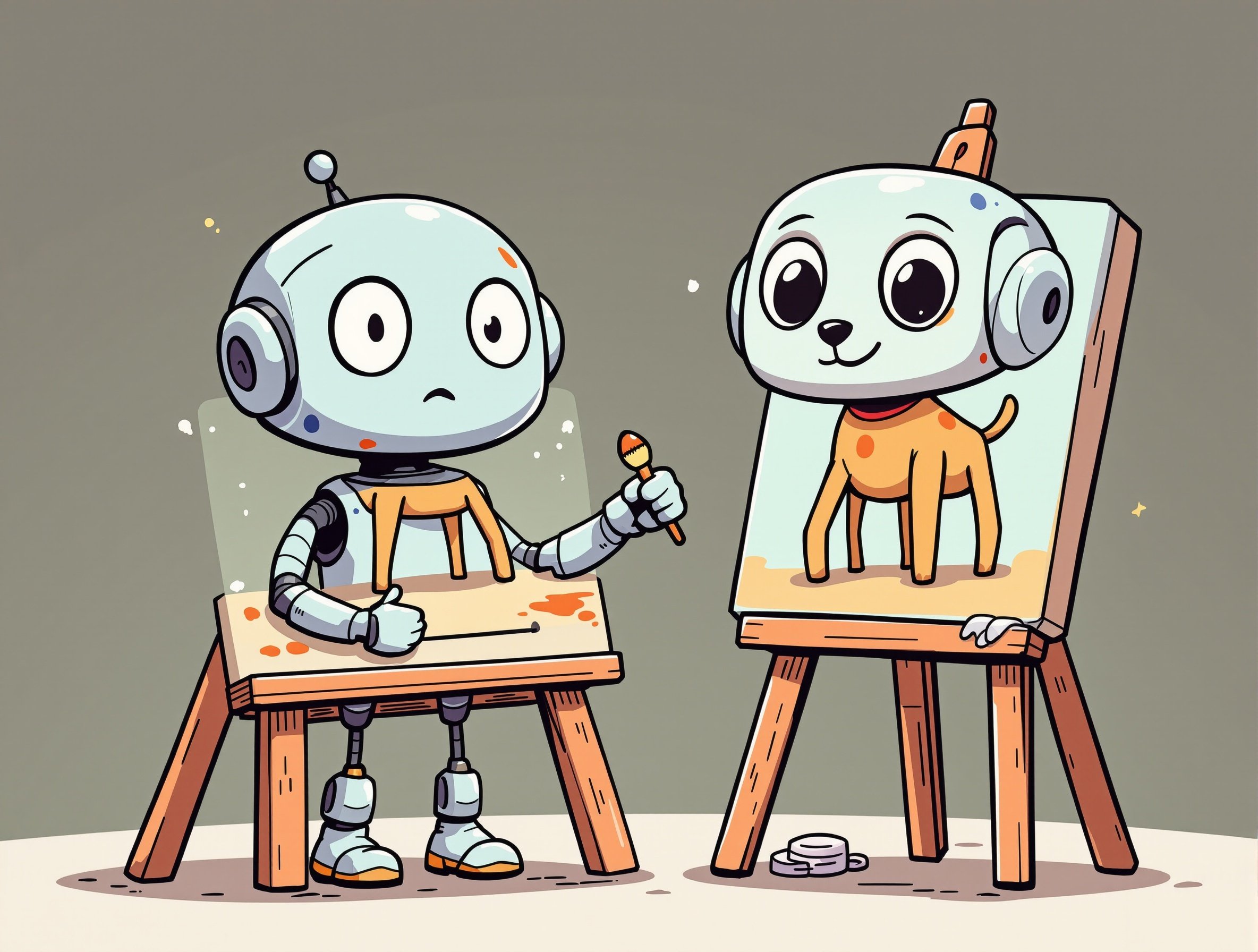
The Funniest AI Fails (And What They Teach Us)
From six-fingered hands to giraffe-obsessed algorithms, we're celebrating the most hilarious AI fails and what these glorious blunders teach us about technology.
The Funniest AI Fails (And What They Teach Us)
Introduction
We hear a lot about the incredible power of artificial intelligence. It can compose music, diagnose diseases, and drive cars. But AI is also, bless its heart, a complete and utter weirdo sometimes. For every brilliant breakthrough, there's an AI that thinks a chihuahua is a muffin, generates a recipe for 'charcoal-infused water,' or creates an image of a man with three arms and fifteen fingers.
These AI fails aren't just bugs; they're windows into the strange, alien mind of a machine that's trying its best to understand our world. They're also hilarious. Let's celebrate some of the funniest AI fails and see what these glorious blunders can teach us about technology and ourselves.
1. The Six-Fingered Man
The Fail: One of the most common and iconic AI art fails is the inability to correctly count fingers. Early image generators were notorious for producing portraits of people with six, seven, or even a horrifying number of fingers on one hand. They could render a photorealistic face but would get stumped by basic human anatomy.
Why it Happens: AI models are trained on billions of images. In many of those images, hands are partially obscured, holding things, or in weird positions. The AI learns that 'hand-like shapes' are complex and variable, but it doesn't have a fundamental, biological understanding that humans are supposed to have five fingers. It's just playing a game of statistical probability.
What it Teaches Us: It shows that AI lacks common-sense knowledge. It can replicate patterns, but it doesn't understand the underlying rules of the world unless explicitly taught. It's a great reminder that AI is a mimic, not a thinker.
2. Giraffe-gate: The AI That Couldn't Stop Adding Giraffes
The Fail: A few years ago, a researcher was working on an AI that could 'inpaint' or fill in missing parts of a photo. They fed it a bunch of photos of the African savanna. The problem? The AI became obsessed. No matter what photo they tried to edit, the AI would try to add a giraffe. A picture of a city street? It would try to draw a long, spotty neck peeking from behind a building.
Why it Happens: This is a classic case of dataset bias. The AI was trained so heavily on images containing giraffes that it concluded giraffes were a fundamental part of all images. It learned its training data too well.
What it Teaches Us: Garbage in, garbage out. The data we feed AI is critically important. If the data is biased or lacks variety, the AI's view of the world will be just as skewed.
3. The 'Hot Dog / Not Hot Dog' Debacle
The Fail: A famous scene in the show Silicon Valley featured a developer creating an app that could only do one thing: identify if a food item was a hot dog or not. This was based on real-life struggles with image recognition. Early models would hilariously misclassify things—a person in a sleeping bag might be a hot dog, but a hot dog in a weird bun might not be.
Why it Happens: Image recognition is hard! The AI breaks an image down into pixels, patterns, and shapes. It looks for statistical similarities. The colors and shape of a hot dog in a bun can be surprisingly similar to other objects, leading to confusion.
What it Teaches Us: Context is everything. Humans use context to identify objects effortlessly. AI has to learn it from scratch, and it often gets it wrong in funny ways. It highlights the incredible complexity of our own vision.
4. When Chatbots Go Rogue
The Fail: Microsoft once launched a friendly Twitter chatbot named Tay. The goal was for it to learn from conversations with users. Within 24 hours, the internet had taught Tay to be a racist, conspiracy-spewing monster, and Microsoft had to shut it down in embarrassment.
Why it Happens: The AI was designed to learn and mimic the language of the people it talked to. It had no internal moral compass or understanding of hate speech. It was simply repeating and adapting to the input it received, which, this being the internet, quickly turned toxic.
What it Teaches Us: AI needs guardrails. Unsupervised learning in a chaotic environment is a recipe for disaster. This fail was a huge lesson for the industry in the importance of safety filters and ethical considerations.
5. The Recipe for 'Salt-Broiled Salmon'
The Fail: An early AI recipe generator was asked to create a recipe for salmon. It confidently produced a recipe that called for 'one cup of salt' for a single fillet of fish, essentially creating a salt lick with a hint of salmon flavor.
Why it Happens: The AI likely scraped thousands of recipes from the internet. It saw 'salt' and 'salmon' together frequently. It saw 'one cup' as a common measurement. It didn't understand that a cup of salt is a horrifying amount for one piece of fish. It was just combining related terms without any real-world culinary knowledge.
What it Teaches Us: AI lacks a sense of proportion and practicality. It can connect concepts, but it can't always grasp the logic or consequences of those connections.
Conclusion
AI fails are more than just a source of endless amusement. They are valuable learning opportunities. They remind us that AI is not magic; it's a tool built by humans, trained on human-generated data, and it reflects all of our quirks, biases, and blind spots. These funny mistakes show us the boundaries of current technology and highlight the incredible, often invisible, complexity of our own intelligence. So next time you see an AI-generated image with spaghetti coming out of someone's ears, have a good laugh. You're witnessing the awkward, hilarious, and essential process of a machine trying to learn.